
Back boilers explained
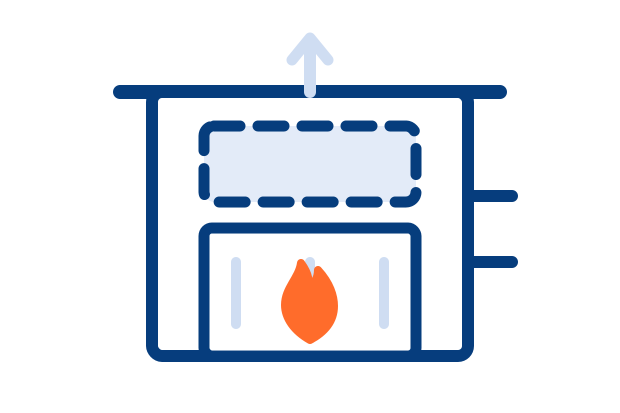
A gas boiler hidden behind a fireplace or gas fire, fitted in millions of British homes between the 1960s and 1990s. No longer manufactured.
Hot water
Stored in a cylinder
Efficiency
Around 55–70%
Status
No longer manufactured
Parts
Scarce or unavailable
The short answer
A back boiler sits in the builder’s opening behind a fireplace, with a gas fire or a decorative front covering it. It heats the radiators and a hot water cylinder in the ordinary way, but it is not a condensing appliance: typical efficiency is between 55 and 70 per cent, against 90 per cent or better for a modern boiler. New back boilers are no longer made and spare parts for many models have run out, so the realistic decision is when to replace rather than whether.
If you still have a back boiler, treat the annual gas safety inspection as essential rather than optional. These appliances share a flue with the fire in front of them, and a blocked or degraded chimney is a carbon monoxide risk. Fit an audible CO alarm in the room.
How it works
The boiler sits behind the fire
A cast iron heat exchanger occupies the fireplace opening, with the gas fire or a blanking plate in front of it.
Both appliances share the chimney
The flue for the boiler and the fire is the chimney itself, usually lined. Its condition is the main safety question.
An external pump and valves circulate
As with a regular system, the pump, motorised valve and controls sit in the airing cupboard.
Loft tanks feed the system
Almost all back boiler installations are open-vented, with a cold water tank and a feed and expansion tank above.
What it needs in the property
A sound, correctly lined chimney flue, checked at every service.
A working gas fire or a properly sealed front where the fire has been removed.
An annual Gas Safe inspection, with a flue flow and spillage test.
An audible carbon monoxide alarm in the same room.
Loft tanks and cylinder as with any open-vented system.
Advantages and trade-offs
Advantages
Out of sight, taking up no cupboard or wall space.
Cast iron construction is robust and many units have run for thirty years.
Gentle on old pipework, because the system is open-vented and low pressure.
Trade-offs
Around a third of the gas is wasted compared with a modern condensing boiler.
No longer manufactured, and parts for many models are unavailable.
Shares a flue with the fire in front of it, so chimney condition is critical.
Removal is disruptive: the fireplace opening has to be broken out and made good.
Some installations contain asbestos rope or panels, which needs handling correctly.
Is it right for your home?
Suits
Nobody, as a new installation. The question with an existing one is whether it is still safe and economic to run for another season.
Less suitable
Any property where the flue is in doubt, where parts are no longer available, or where the heating bills would repay a replacement within a few years.
Sizing it properly
Replacement is sized from scratch rather than matched to the old appliance, because a back boiler was typically oversized and a modern boiler modulates. Most back boiler replacements end up as a system or combi boiler in a different position altogether.
Combi replacement
One bathroom, cylinder and tanks removed
System replacement
Two bathrooms, cylinder retained or renewed
Fireplace made good
Opening bricked up or left as a feature
We size from a heat loss calculation and a measured mains flow rate, not from the output of the old boiler.
Book a surveyWhat goes wrong
Pilot light will not stay lit
A failed thermocouple, which on many models is no longer available as a part.
Leaking from the fireplace
A cracked cast iron section. This is the end of the appliance rather than a repair.
Fire works, heating does not
Often the external pump, the motorised valve or the boiler thermostat rather than the boiler body.
Staining or soot around the fire
A possible sign of spillage from the flue. Stop using it and have it tested.
Back boiler questions
Get a fixed price
Send the property details and a photo of the existing boiler and we will quote the whole job in writing, itemised.