
Regular boilers explained
Also called heat-only or conventional. A boiler, a hot water cylinder and one or two tanks in the loft — the setup in most pre-1990s British houses.
Hot water
Stored in a cylinder
Space needed
Cylinder plus loft tanks
Best for
Older houses, weak mains
Depends on
Loft access and headroom
The short answer
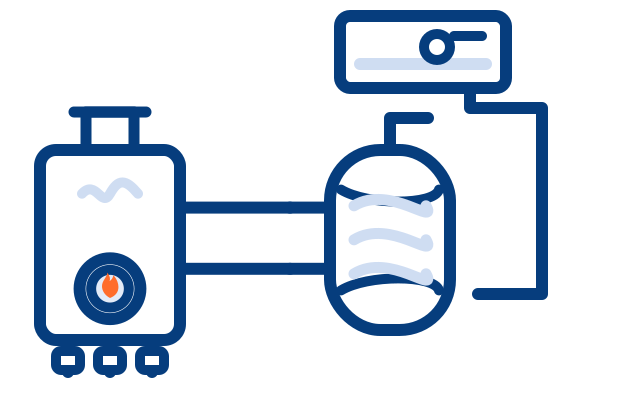
A regular boiler heats water and nothing else: the pump, the expansion and the water supply all sit outside the appliance. A large cold water storage tank in the loft feeds the cylinder, and a small feed and expansion tank keeps the heating circuit topped up. It is the oldest arrangement still installed, and it remains the right answer in some properties — usually where the pipework is old, the mains supply is poor, or the loft tanks already exist and work.
How it works
Loft tanks feed the system
A cold water storage tank supplies the cylinder and the taps; a smaller feed and expansion tank serves the heating circuit.
Gravity provides the pressure
The head of water between the loft and the outlets sets the pressure, which is why upstairs showers are often weak without a pump.
An external pump circulates
The pump, motorised valve and controls sit in the airing cupboard rather than in the boiler.
The cylinder stores hot water
A coil inside the cylinder is heated by the boiler, with an immersion heater as a backup.
What it needs in the property
Loft space and headroom for a cold water storage tank, insulated against freezing.
A feed and expansion tank with its own overflow to outside.
Airing cupboard space for the cylinder, pump, valves and wiring centre.
A gas supply and a flue position as with any gas boiler.
A shower pump if upstairs pressure needs to be usable.
Advantages and trade-offs
Advantages
Gentle on old, fragile pipework that a sealed system might push leaks into.
Works regardless of the incoming mains pressure, because the loft tank does the work.
Cheapest option where the tanks and cylinder already exist and are sound.
Simple, well-understood components that most engineers can repair.
An immersion heater gives hot water if the boiler is out of action.
Trade-offs
Two tanks in the loft: freeze risk, overflow risk and lost storage space.
Low pressure at the taps unless a pump is added.
The most components of any system, so the most to go wrong.
Open to the air, which means more corrosion and sludge over time.
Slowest to reheat once the cylinder is emptied.
Is it right for your home?
Suits
Older houses that already have the tanks and cylinder, properties with a weak or shared incoming main, and systems with original pipework that would not take sealed pressure well.
Less suitable
Flats and new builds with no loft, properties where the loft is a converted room, and anyone who wants mains pressure showers without adding a pump.
Sizing it properly
Boiler output follows the heat loss of the property and the radiator count. The cylinder is sized by occupancy, and the loft tank has to be large enough to feed the cylinder without running dry mid-bath.
15–18 kW
Small house, up to eight radiators
18–24 kW
Three-bedroom house, ten to twelve radiators
24–30 kW
Larger house or high heat loss
We size from a heat loss calculation and a measured mains flow rate, not from the output of the old boiler.
Book a surveyWhat goes wrong
Overflow dripping outside
The ball valve in a loft tank has failed or the float is set too high. Cheap to fix and worth doing before it stains the brickwork.
Cold radiators upstairs
Air drawn in through the open vent collects at the highest points. Bleeding usually clears it; repeated air means a different fault.
Frozen loft pipework
Tanks and pipes in an unheated loft need lagging and a tank jacket. A burst after a cold snap is the usual consequence of neither.
Noisy or seized pump
The external pump is a wear item and can be replaced without touching the boiler.
Regular boiler questions
Get a fixed price
Send the property details and a photo of the existing boiler and we will quote the whole job in writing, itemised.